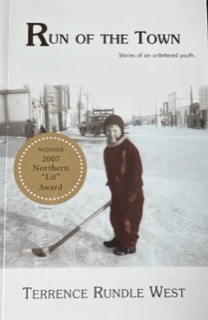
Guest Post by Terence Rundel West –
Somewhere between books two and three in my writing, a friend steered me onto a novel by a Michigan author I had never heard of. My friend was certain I was going to love it because it was set in Northern Ontario, with a major scene in my home town. Getting into the book I quickly discovered that all the ingredients were there—pace, pathos, suspense, interesting characters. Clearly, the man was talented. But from the start I recognized that there was a problem—I knew the territory in which the book was set, this man did not. The whole story took place in my zone, Northern Ontario, a region I knew intimately, having grown up there in a small lumber town among French Canadians, Finns, Slovacs, German Prisoners of War and displaced Japanese from the west coast. (Yes, sad to say, Canada did place our Japanese citizens in concentration camps in WWII). Completely off the mark were the physiography, climate, wildlife, policing methods, not to mention the physical scale. It turned out to be a painful read.
Obviously, the author had never set foot in the territory. My friend, who did not know Northern Ontario, had loved the book. For me, I couldn’t bring myself to finish it. But it got me to thinking seriously about the importance of setting. This hadn’t been a concern with books one and two because they had been set in my northern comfort zone. But book three had me stepping into strange territory. In this novel, set in the Great Depression, two young men rail-rod their way across Canada running up against all the political isms of their day and experiencing events that eventually catapult them into the Spanish Civil War. With a background in history and geography and widely travelled, I’d believed a stay-at-home, armchair approach would be sufficient to get the setting right. The Michiganian’s book proved the folly in that.
It wasn’t that I’d ignored setting in books one and two, it was more that my focus had been on plot, structure and getting in all the requisite literary ingredients—foreshadowing, suspense, dialogue, character development, metaphors, point of view, pace. Essential stuff, of course, especially when the goal is to keep the reader turning pages. I had assembled a checklist for final cleanup before turning the manuscript over to the editor. My list contained twenty-three items that I considered essential. You’d recognize them. They’re stock and trade. Twenty-three points, none of which paid adequate attention to setting.
When I finally did get around to walking the ground for book three, I was astounded by the holes in my understanding of the setting. Woefully lacking was close awareness of micro regional realities—vegetation, climate, physiography, buildings, scale. For example, one of my scenes has the protagonist caught up in the Regina, Saskatchewan riots of 1935. It was a chapter written before visiting the area and one I thought had gone pretty well. Only by walking the streets was I struck by my own hubris. My geographic scale of the city was badly out of kilter. Steet blocks turned out to be longer than in my mind’s eye, making it impossible to arrive at points in the time frame I’d allowed. Similarly, a park, into which I had crammed a horde of people, proved to be postage stamp in size. Result? A complete rewrite of the scene.
I could cite other examples—a bridge scene in the Spanish Civil War that was away off (book three); geographic errors in the 1846 conflict scene between the Blackfoot Confederacy and the Cree Alliance, south of Fort Edmonton (book four); the 1944 scene with the Russians bombing Helsinki, Finland (book five). In these and other cases, walking the ground rescued me from countless omissions and errors—micro weather patterns, elevational changes in vegetation, topography, river width, river volume and flow, unexpected variations in demography, land use and ethnic origins.
Leaving your comfort zone is perfectly acceptable, providing that in addition to the armchair research you do a good, old-fashioned, boots-on-the-ground inspection. Readers are a forgiving lot. They will accept mistakes. But only up to a point. Go beyond that and your book winds up gathering dust on the shelf. If the setting is flawed, and happens to be one the reader knows intimately, the magnifying glass is certain to come out, just like mine had with the Michiganian’s book. At this point nothing can save it. Even your carefully crafted plot, characters, and imagery will not be enough to rescue it from the dust bin. Cutting corners is not worth the risk.
Terrence Rundle West is an award-winning Northern Ontario writer. A former teacher and school administrator, he now lives in Ottawa with his wife Peggy.