Guest Post by Patricia Bracewell –
Because conflict usually causes agonizing disruption in our own lives, it is something we try to avoid. Yet conflict is what make the imaginary world of a novel utterly compelling. It is the engine that drives a story, no matter the genre. But unlike writers in other genres, historical novelists must reach into the past, must root the conflicts portrayed in their novels within the history and culture of their chosen historical periods. Conflict then becomes a way to not only move the story forward, but to immerse readers in that other time and place.
There are three types of conflict that should be in every novelist’s toolbox: Against Others, Against Nature, and Against Oneself. And because a writer cannot rely on just one type of conflict to carry a story all the way through to the end, all three should appear within the pages of any novel. The historical novelist, though, must mine the past to find them.
Conflict Against Others appears in most novels, and is the easiest to recognize. In Bernard Cornwell’s Saxon Tales, for example, every book is suffused with sweeping clashes between Saxons and Danes in 10th century England. War, though, is only one aspect of such conflict. Ambition, resentment, suspicion, and rivalry can lead to conflict that is far more subtle and is conveyed through dialogue and internal monologue as well as through action. Each of Cornwell’s novels explores such personal conflicts between the major characters, whether it be the frequent opposition of his invented hero Uhtred to the demands of the historical figure King Alfred, or Uhtred’s efforts to outwit the assortment of villains drawn from history who populate his books. All the conflict, though, is grounded in the historical setting of the novels, and much of it is pulled from the historical record. For example, the scene where Uhtred’s men lob skips buzzing with bees at a besieging enemy might seem fanciful and highly unlikely—yet Cornwell modeled it on something that actually happened in 907.
Which brings me to Conflict Against Nature. Pestilence, foul weather, the very real hazards of getting somewhere on a ship, a horse, a cart or on foot—especially if time is a factor—all of these add drama and tension to any story. Lauren Groff’s recent novel The Vaster Wilds is set during what is now referred to as The Starving Time in Colonial America, when 1609 Jamestown was beset by starvation and smallpox—plenty of conflict right there. But her heroine escapes from the settlement only to grapple with one terrible ordeal after another as she makes her way through the American wilderness. She struggles against fierce cold, raging rivers, wild animals, and gnawing hunger that she assuages by eating oysters, berries, roasted baby squirrels, and grubs. Eventually even her body turns against her—not surprising, considering her diet. It is not a story for the fainthearted, but the reader cannot help but identify with her, admire her fierce determination, and want her to survive—want her to make it through the next obstacle that Groff throws at her. And those obstacles are drawn from the author’s research into survivalist texts as well as accounts of early settlers who had been captured by Indians. She grounds her story and its page-turning conflict in the 17th century.
Groff gives us Conflict Against Man, as well, in the events that have forced her heroine to flee Jamestown in the first place and in flashbacks to her circumscribed life before she was carried without her consent to the New World. She gives us, as well, the third type of conflict, Against Oneself, as she places us in the mind of her heroine and we are witnesses to her incredible mental anguish, for she is running from herself as well as the 17th century civilization that she has left behind.
In The Marriage Portrait by Maggie O’Farrell we enter into the main character’s internal conflict in the first paragraph as she realizes that her husband, seated beside her at the dining table, intends to kill her. Except that, a few paragraphs later, she questions that assumption. Perhaps she is mistaken, she thinks. Her uncertainty—that conflict within herself—thrums menacingly below the surface of the entire novel as the author slowly reveals both Lucrezia’s personality and her husband’s, as well as the 17th century world in which they live.
Conflict Against Others in this novel is subtle as well because her enemy is not a single person, but the entire culture of 16th century Italy that keeps her confined within palace walls from childhood and into adulthood, just like the animals her father actually kept in subterranean cages. And yes, the cages really were there, commemorated still by the name of the street in Florence that bordered their prison, Via Dei Leoni. The Street of the Lions.
So, conflict is hugely important to keep in mind when writing a novel. With every scene that we pen we must ask the question: What is the conflict? What is the focal character grappling with? Fear, guilt, indecision, frustration, anger, forbidden passion, political rivalry—these all lead to turmoil with which to torment our characters. And torment is the operative word here. The last thing a writer wants to do is to make things easy for the characters in a novel. Torment and conflict are the spurs that drive characters into action and keep readers invested in our stories. However much we love our characters, we have to make them suffer until almost the very last page. It also enlivens stories with rich detail. Don’t lose those pieces of historical gold. Happy hunting!
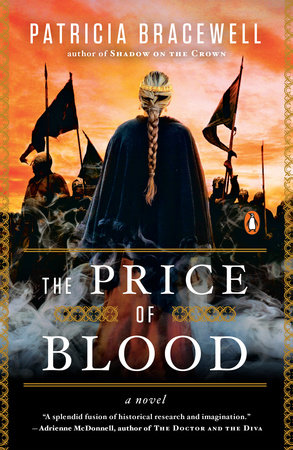
Patricia Bracewell’s historical novels about Emma of Normandy, the 11th century twice-crowned queen of England, include Shadow on the Crown, The Price of Blood, and the Chaucer Award winning The Steel Beneath the Silk. Her research has taken her to Europe many times, including a summer course on Anglo-Saxon history at Cambridge. She has served as Writer-in-Residence at Gladstone’s Library in Wales, has been a panelist and speaker at literary festivals and conferences in the U.S. and Britain, and has spoken to numerous book groups and school groups about her novels and the history that infuses them. She is currently working on her fourth historical novel about Queen Emma.